Saturday, September 30, 2006

Sweet, Sweet Memories


I will be leaving next week to visit an aunt in Phoenix. My mother, another aunt, and I will be accompanying my grandmother on this trek west. Probably not anything unusual but we are very nervous about it as my grandmother was diagnosed two years ago with Alzheimer’s disease. We aren’t sure how the trip will go – she no longer adapts well to change. She knows we are going on vacation and is very excited – we’re just not sure she understands how we are getting there. So – family has been on my mind lately.

Family is very important to me and they always come first – although they might complain that work does. So, when I find text that makes personal connections I am thrilled. I can share it with others to model where authors get their ideas and to show that we can write about even the smallest things. I recently found a new mentor text for me courtesy of my nieces Scholastic Book Club.

The Hello, Goodbye Window by Norton Juster with pictures by Chris Raschka gives a child’s version a visit to her Nanna and Poppy. To get to their house, everyone must pass by the kitchen window (the Hello, Goodbye Window) – which looks like a regular window but it’s not. The child tells details about her grandparents and what they do during their visit – all with great connections.

Here are some of mine:

“The kitchen is where Nanna and Poppy spend most of the time. So you can climb up on the flower barrel and tap the window, and duck down and they won’t know who did it, or you can press your face against the glass and frighten them.”
My grandparents kitchen was in the back of the house with a big window. My Babcia often sat at the kitchen table playing solitaire, my DziaDzia sitting at the end of the table reading the paper. At night – you could see the glow of the light and know Babcia might be washing dishes at the sink, while my DziaDzia was eating that day’s sweet treat. My father would hold us up to knock on the window and eventually, we could reach it ourselves. Of course, when he heard us coming in, my DziaDzia would hide and jump out to scare us when we actually entered the house.

Of course, the kitchen was rarely empty and often had various other relatives in it as well. My grandparents house seemed to be the center of the universe – where everyone gathered for the cake and pretzels that were in endless supply, to play a quick hand of cards, to have a cup of tea on the way to run errands, to just get love.

“Nanna says she even used to give me a bathe in the sink when I was little – really!”

There are many, many of those photos tucked away in my family, all with the requisite soapy hairdo of course. My mother has carried on the tradition with her own grandchildren. And since she has a very large stainless steel sink – they took baths in there just a few weeks ago, even though they are five and three!! What is it about the kitchen sink bathtub that brings back such great memories?

“When we leave we always stop at the window to blow kisses goodbye.”


Leaving was never something simple and could often be a 20 minute ordeal. My Babcia would stand in the window while my DziaDzia would walk everyone to the car. We’d blow kisses to everyone and keep waving until we pulled out of the driveway and down the street. In nice weather, they’d even walk to the end of the driveway to wave good-bye. It made you feel as if you would be missed – and that you needed to go back soon.

My grandparents’ house was something special.

Wednesday, September 27, 2006

Writing 'Round the Web

I thought I would take the time to share what some other folks are doing with writing in the incredible blog world we live in. I have most of these folks in my Bloglines account - you might want to consider creating one yourself after you start reading!!


First, A Year of Reading tipped me off to a site that writes haiku for every New Yorker article. I'll admit it, at first I thought "This person has waaay too much time on their hands!" Then I thought,

For current events
We want kids to summarize
Why not a haiku?


Sorry - couldn't resist!

Bud the Teacher made some connections to what I am trying to do here when he shared a post from Kevin's Meandering Mind asking teachers to contribute to a book he is writing in collaboration with researchers from the University of Massachusetts Amherst:

Practically everyone agrees that writing is changing, as writers compose more on screen than in previous generations. But how has this change in what we consider “writing” affected teachers’ classroom practice? In the context of emerging multiliteracies, what are teachers’ goals for their students’ learning? How have teachers revised their definitions of writing in the age of digital literacy? How are these expressed as changes in their classroom practice? And what new writing do the students produce?


Consider reflecting on your own practice and contributing to this!

Finally, Coot Cat Teacher shares some powerful lessons about peer review. It seems that another great teacher is having their students conduct a peer review of the work Cool Cat's kids are doing on a wiki. The kids give some great feedback about writing/storytelling in this digital world. What a great exercise and way to get authentic feedback!!

Of course, reading and writing are closely connected so you may find these links interesting as well. David Warlick over at 2 Cents Worth hooked me up with a powerful article that I will be using a lot entitled "What is the worth of words?" The article talks about a the results of an adult literacy assessment which found that the reading proficiency of college graduates has declined in the past decade. The most powerful part of the article is an editorial predicting the rate of decline by 2025. (Hmmm....before you read the article, knowing that no child will be left behind by 2014, what do you think the state of reading might be?)


And of course, Will Richardson continues to push our thinking with his recent article at The Pulse on what reading means in this new Web 2.0 world. From that article, here are some final questions for you as you consider reading and writing in YOUR classroom:
Most importantly, as a school leader, are you thinking about how this newenvironment plays out for your students? Are these new literacies a part of your school's curriculum? Students are reading and writing (in manydifferent media) in these spaces already, but are we teaching them how to do it well? Are they learning to become editors as well as readers?

Friday, September 22, 2006

Diffendoofer Philosophy


Okay – so I don’t really use this book for writing. But given that we have finally received the ELA scores for our state and everyone is clamoring to see how neighboring districts fared in comparison and trying to figure out where to lay blame, I thought I would share Hooray for Diffendoofer Day!!

Created from the last sketches of Dr. Seuss – this book honors those teachers who truly are “outside the box” and put their students, not tests, first. Ironically, those teachers are embodied by a teacher named Miss Bonkers! Students at Diffendoofer learn” how to tell chrysanthemums from miniature poodles” and other important skills. But then comes the TEST!! Students must pass a standardized test or face going to Flobbertown where everyone does things the same. But the students are inspired by Miss Bonkers who proclaims “"We've taught you that the earth is round,/ That red and white make pink,/ And something else that matters more-/ We've taught you how to think." Low and behold, and without test prep, the students of Diffendoofer school pass with a mathematically impossible, but nonetheless amusing percentage.

I have come to firmly believe in what I call the Diffendoofer Philosophy: that if we teach to student interests, give them choice, and engage them in thinking, the will be able to pass any test that is thrown at them. It is the same with writing – we don’t need to give them four document based questions a week or have them write essays to inauthentic prompts in order to teach them to write. We should encourage their creativity, nurture their enthusiasm, and promote risk-taking in their word choice. In other words, make it enjoyable and not a chore.

I believe we can do it– Business First be damned!!

Tuesday, September 19, 2006

Reading-Writing Connection

The Center for the Book in the Library of Congress, in partnership with Target Stores and in cooperation with affiliate state centers for the book, invites readers in grades 4 through 12 to enter Letters About Literature, a national reading-writing contest. To enter, readers write a personal letter to an author, living or dead, from any genre-- fiction or nonfiction, contemporary or classic, explaining how that author's work changed the student's way of thinking about the world or themselves. There are three competition levels: Level I for children in grades 4 through 6; Level II for grades 7 and 8, and Level III, grades 9 - 12. Winners receive cash awards at the national and state levels. For information contact the LAL Project Director at lettersaboutlit@epix.net.

You have got to read the amazing work from last year's winners!!

Sunday, September 17, 2006

A Little Cheese with that Whine?

Participants in my writing workshops have heard me get on my soapbox about the value and power of a good rubric. (In fact – I rarely limit this to my writing workshops, this is how strongly I feel on the topic!) I firmly believe that we need to provide students with explicit criteria for their success in order to give them a fair shot in education. To that point – I have often shared a rubric on whining that I have internalized when working with teachers and students!!

Via A Year of Reading I found this great companion piece to the rubric which would also make a great listening/note-taking exercise for students. NPR recently held an interview on “The Joys and Perils of Whining at Work’ with Renee Montagne. This 3 ½ minute snippet is great for students to use with 2 column notes (Step Up to Writing strategy). I also envision students writing their own “whines” (voice!), writing their own rules for “Whining in the Classroom” (voice, organization, ideas), or making their own “Joys and Perils of (BLANK) in school podcast (ideas, voice, integration of technology!!)

I am still playing with how I might use this myself but the ideas are certainly flowing – look for it in a workshop soon!


Image from The New Zealand Herald, "Work, the horror of it all."

Friday, September 15, 2006

Constitution Day!


With Constitution Day on Monday, I thought I would share with you two GREAT books that not only look at writing but also focus on this historical document!


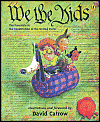
The first is "We The Kids" illustrated by David Catrow. The text for this is the preamble to the Constitution, but the illustrations help students to understand the difficult words and concepts contained within. I have posted a 6 Traits lesson plan for this book on my wiki.


The second is Shh! We're Writing the Constitution by Jean Fritz with illustrations by Tomie dePaola. This is a great book for grades 4-6 and Jean Fritz does a first rate job showing the personalities of our Founding Fathers and telling the story of the creation of this document with trivia mixed in. In addition to tradition writing activities like creating a class constitution or Bill of Rights, this book is an excellent piece of literature to begin discussing voice.


One final note for older students, there is an excellent lesson plan in the September issue of Social Education from the National Council for the Social Studies on The Founder's Library. The lesson is based on a permanent exhibit at the National Constitution Center in Philadelphia and has students examine the ideas and writings that influenced the Founding Fathers. A great lesson for examining historical documents but also for referencing the power of prior knowledge.

Saturday, September 09, 2006

Better Late Than Never!!


Wow! Friday comes fast in a shortened week! My apologies for having the Friday book posted on Saturday morning!!

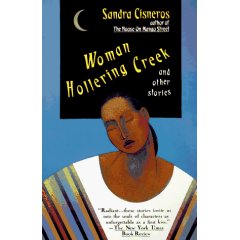
Since it is the first week of school for kids, I thought I would share one of my favorite adult reads that has a poignant story right in the middle. Woman Hollering Creek: And Other Stories by Sandra Cisneros is a collection of stories about Mexican-American women. Throughout the book, the author uses powerful descriptions of people and places that excerpted would be wonderful examples to show students about the power of details. (My own copy has many, many Post-It notes for this very reason!)

However, the most compelling lesson and one that extends far beyond writing, is in the short story “Eleven.” This quick four pages tells the story of a girl on her eleventh birthday and a powerful moment in school that will mark that day forever in her mind. It has great descriptions, powerful voice, and is sure to evoke many memories from the reader.

My favorite writing activity to do after reading the story is to have the readers retell the story through the eyes of another character in the story (the worksheet and directions for this can be found on my companion wiki). It is great to hear the stories that come from participants with this activity and more importantly, to ask them where the inspiration for the story came from. In fact, many are reluctant to put the writing away and often finish it so that they can share it with their students. A great lesson exercise to practice the trait of voice.

Happy reading!

Friday, September 01, 2006

If it's Friday, it must be.....


In order to keep myself focused on writing and the tools that we need to teach writing well – I’ve decided to make every Friday a “Reading to Help Teach Writing Day” in which I’ll share the books that I use (and find) to help teach writing.

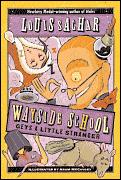
Since the opening of a new school year is here – I thought I would start with Wayside School Gets a Little Stranger by Louis Sachar (author of Holes). I love this entire series but this book in particular is rich with writing connections!!

Chapter 11 is titled “Voices” and is great for those teaching using the 6 Traits. The students are all introducing themselves to Mr. Gorf (a substitute teacher) and the voices are all unique!! Sharing this chapter with students helps them with the trait of Voice, as well as Ideas and Word Choice. Particularly relevant for those who might be teaching dialogue in writing.

I also like Chapter 14, “A Light Bulb, A Pencil Sharpener, a Coffee Pot, and a Sack of Potatoes” when working with Step Up to Writing and two-column notes. This chapter covers a science experiment on gravity, in which the students try to determine which object dropped from the window will arrive at the ground the fastest. I start with reading the title and asking “Which of these would hit the ground first if we dropped them from 13 stories up?” Students would write their guesses in the upper right hand corner of the paper. I then have students fold their paper in half (hot-dog style!) and write each of the objects in the right hand side. I explain that I am going to read the story aloud and as they hear about what happens in the story – they should “jot” notes in the right hand column. I remind everyone that “jot” means just one or two words – not copying everything that I say!! After reading the story, I ask students to look at their original guess about which object would hit the ground first and see if they were correct. Depending on the classroom – the discussion could go on from here: more note-taking, writing a paragraph, or even launching a gravity lesson!!

Chapter 5, “A Story With a Disappointing Ending” is another gem to help students with crafting their own endings and nice “hook” to dealing with conclusions.

All in all – Wayside School Gets Stranger is a quick and entertaining read rich with writing connections!! Enjoy! And Happy First Day of School!!

Thursday, August 17, 2006

The Dwarfs vs. The Supreme Court

A recently released poll on pop culture indicated that three quarters of Americans can correctly identify two of Snow White’s dwarfs while only a quarter can name two Supreme Court Justices. What does that mean for how we teach?

When working with new teachers and mentor teachers– one of the key questions I ask is “How are the students today different from students when you were in school?” I am sure you can run through the list of answers in your head. Perhaps I should start following that question with “What are we going to do about it?”

At the High School’s New Face conference in Ellicottville this July, I was fortunate to be surrounded by fabulous teachers from our region. Everyone was learning and reflecting on their classroom. Richard Strong and Harvey Silver spoke to one group about engaging students – one of the most powerful things I think everyone took away from that workshop was “Call them by their name.” How many of us take the time to make that personal connection with our students? It doesn’t take long – a couple of seconds – to recognize the children that are entrusted to us. But do we do it?

It’s made me think a great deal about my classroom and what I did well and what I could have done much, much better. I took great pride in learning student names and in learning what interested them, so that I could “hook” them into American History. I’ve started to think about how that information can transfer over into the realm of education I find myself in now: professional development and facilitating curriculum conversations. Having blogged once – I have found the power of communicating with others as I ponder these heady issues and so I have started a second blog for those who were in that session with me – as well as those who are interested in engaging their students and the work of Silver and Strong. We learn from what we are interested in and we learn best from our peers – think about joining in and commenting on my blog or better yet, creating your own!!

Another group at the conference met with Will Richardson and worked on the role that technology plays in “connecting” the 21st century teen. That group came out incredibly excited about what they have learned and I have been following two of them closely. Kim Moritz is a local principal and has been very open and honest in her blog about education and leadership. A great and thought provoking read!!

Pat Aroune is a local social studies educator with great passion for the subject and I have recently peeked in on what he plans to do with his students next year using this new technology. Pat already experimented with blogging this summer and here is what one of his students wrote, “It was great to be able to write about what I want; one would be amazed at how much one writes when discussing a topic of great interest. It was much more fun to learn the chapter keywords in a context that we ourselves understand, rather than simply trying to understand the textbook-given example. Also, I feel that synthesizing information and context is learning on a much higher level than simple "copy-it-out-of-the-textbook" busy-work.”

Or how about this one: “This was challenging for me because I am used to traditional and boring route of education. I have become a robot in school, just doing what is asked and creativity is rarely involved. With this new way of comprehending economics, I was forced to look beyond tradition school work and thinking process, and actually think a little.” Great job, Pat!!

So much excitement, so much to learn – and yet when I look back at a recent Will Richardson post and the comments I realize we need to slow down and ponder what is “best practice” in this new, flat world we live in. While Will’s post, and those of many others that I have been following, speak explicitly about the best practices in using blogs, wikis, and podcasts in education – aren’t we still talking about the best practice in educating our youth? How do we prepare our students for the ever changing world in which we live in? One that has “fragile” cease fires? Where you can no longer bring toothpaste or water on an airplane? Where information (and mis-information) flows faster than ever before? If we don’t use technology, the same technology our students use, we will lose them!!

But we still run across educators who downplay the role that technology plays in education, those that feel that by using technology – we are somehow caving into the outside world and not providing a “real education.” Get on board!! Or as Ewan McIntosh said much more eloquently:

“The arguments that new technologies are just a fad, a cherry on the cake, an added extra, a bolt-on, a treat, something we can pass by, nothing that a good PowerPoint can't supercede, nothing that a textbook hasn't achieved until now, nothing that our best exam factory schools can't do without... all of this is is just keich. The teachers touting this must wake up to the fact that they are not engaging their kids unless they do use these technologies, the ones the kids use. Moreover, they're not really preparing them how to cope with the information being passed over to them unless they teach how to manipulate and analyse that information with these tools.”

Monday, August 14, 2006

Things that make you go hmmmm....

Teaching our students to be discerning consumers of media has been a hot topic among educators this summer. Here are some interesting links to ponder as you prepare your students for research in the upcoming school year…..

One of my favorite blogs on my Bloglines account is from a math educator in Canada. (Yes, I said MATH!) In addition to the GREAT stuff he has done with his students, a recent post about South African wikis really caught my eye. Apparently, many experienced educators have been pointing to South Africa as a leader in using technology as their national curriculum was posted in a wiki. Alas – upon further investigation, and discussion with South African educators who were surprised by this information, it was discovered that this information might not be true!! Even more helpful are the comments to the posting which refer to how this site might be used for educational purposes.

Donna R., one of my favorite 5th grade teachers, shared this website with me that she plans to use with her students before embarking on a library research project using the Internet. While the site looks very professional – complete with maps and news articles referenced in the sidebars – the very bottom promotes an organization called “People for the Ethical Treatment of Pumpkins.” What a great site to visit and apply those critical thinking skills!!

If are thinking about using blogs in your classroom, the Cool Cat Teacher has a great posting on making comments. Point #6 about teaching commenting really hits home when you read the words of a third grade blogger. And of course, #7 on the power of words hits close to home for me!!

A recent find for me (from reading waaaay too many blogs!!) highlights a super piece of student writing. It has made me ponder ways in which I might be able to incorporate authentic student voices into my blog as well. (HINT! Send me your excerpts to share! We are all about improving student writing after all!)

Finally, Will Richardson has an excellent and thought provoking blog on the use of technology in education. If you don’t have your copy of Blogs, Wikis, and Podcasts – run, don’t walk, to the nearest bookstore (real or virtual) to get your copy. Even if you don’t think this is the way of the future – you have to have read about it to engage in conversation about it. Will’s most recent blog links to some “light” reading on “Obstacles to Educational Uses of Copyrighted Material in the Digital Age.” I’ve only skimmed the table of contents and the case studies seem to be something that every educator should read – especially social studies teachers!!

And of course, my posting would not be complete without some reference to mentor texts!! These two teachers are doing a pretty powerful job in sharing their own learning through literature in their quest to have read the Newbury Award winner – not to select it, but to have read it before selection. They have also started a pretty interesting list of the 100 Cool Teachers in Children’s Literature. They are only up to 58 so it’s not too late to weigh in!! Besides being a great resource blog – can we say awesome professional development?

Phew!! This ought to be enough to get any newbie started and lost in the world of weblogs and wikis!! I have just begun the journey myself and what an interesting ride!! Please share some of your “highlights” here as well!

Tuesday, August 08, 2006

Sticks and stones may break my bones...

Words are very powerful weapons. They hurt. They soothe. They ignite fire. They calm raging waters. They can raise you up and back-fire on you. Words are loaded with meaning, embedded in riddles, and can have different meanings depending on the accent given.

Fire! Fire? FIRE!!

Two separate studies reviewed the vocabulary of Webster’s Third International Dictionary (1963) and found that when compound words, archaic words, abbreviations, proper names, alternative spellings, and dialect forms were excluded and the remaining words could be classified into 54,000 word families!! Our students are bombarded with new words on a daily basis, but we also expect them to choose their words wisely. How can students master this many words? What about English language learners?

We need words and we teach words. But do we teach students to love them? To treat words with respect? To recognize the power that words have when they learn them?

I spent three years in law school, and almost the same amount of time in practice, learning how to use words to my best advantage. I think they did a pretty good job; when backed into a corner, I can use them to back my verbal opponent into the opposite one. I can see the weakness in their arguments, craft mine in my head to counter it, and spititoutsofastthattheydon’thavetimetothinkyetalonerespond. I win!! But interestingly, when a friend is grieving over the loss of a family member or the dissolution of a seemingly rock-solid marriage, I falter. Words escape me and the only thing I can stammer out is “I’m sorry, I am so sorry.”

Words have come to the forefront lately as we seem to trip over them in education. We need to be careful with what we say so as not to offend or hurt so we couch their meaning in other words which don’t really mean the same thing and not everyone has access to the code so they think we mean something entirely different we talk about what is important to us. Huh? In other words, why have we stopped saying what we mean?

I am obsessing over words because I have spent the past two days working with very dedicated educators to review ELA testing items for our state assessments. In the course of our discussions we have been dissecting words: what grade level they are appropriate for, whether our students would know them, how to teach them. But we don’t talk about how to teach students to love them. Truth be told – the process is starting to kill my deep affection for them! But it has made me wonder about how to empower students with the nuances of our complicated, illogical, often misused language.


Tuesday, August 01, 2006

Those Lazy, Hazy, Crazy Days of Summer

It is one of the hottest days of the summer today. Our record temperature and heat index might not mean much to those in Phoenix used to triple digit temperatures – but here in Western New York it is down-right H-O-T. The air is heavy, people are cranky, and my hair is out of control!!!

So it was nice to relax after work floating in the pool with my nieces. They have just discovered the power of words in the worst form of torture known to man: knock-knock jokes!! I suppose it is all worth it to see them doubled over with genuine belly laughs when they actually get one – but the jokes lose their appeal after about 3 minutes. Knock-Knock! Who’s there? Amsterdam Amsterdam who? Amsterdam tired of all these knock-knock jokes!

But they are only this young and innocent once and I cherish every moment that I get to spend watching them grow and develop into the beautiful, intelligent young ladies I know they will become.

So it strikes me that we don’t often take the same opportunities to step back and enjoy the moment with our students. We are worried about covering the breadth of our curriculum, racing towards the finish line of a state or district assessment. In this mad dash for completion, we forget to step back and model reflection and revision – good teaching practices that we throw out as unneeded ballast.

I am not the only one noticing this interesting trend.

Dana wrote in response to a previous posting
about the time she has spent with students in summer school on the thinking process: “Sometimes we forget, good teaching and commitment always will be the answer to test scores.”

And Melodee shared: “The last two days I have spent with a speaker at our school who talked about the reading strategies and the importance of modeling them, as well as giving children time to discuss, reflect and write. Of course as you and I both know many a teacher asked the age old question, "How do we fine time to do all this?"

Not sure that I have the answer, but what if we all tried a noble experiment. Instead of lamenting that “I have to teach X”, let’s instead proclaim “I get to teach X.” Imagine what would happen if we changed our mindset to think of our teaching as an opportunity!!!

Now – this experiment won’t be easy. Our peers will scoff, administrators may look astray and step to the other side of the hallway as we approach, and family members may begin looking into resort spas as therapy. Some of these may not be bad by-products of our experiment. But my hypothesis is that the true result of our experiment is that our students might actually enjoy what we are teaching – even if it is writing!!

"Opportunities are usually disguised as hard work,
so most people don't recognize them."
- Ann Landers

Tuesday, July 25, 2006

It's all about ME!

The hawk lazily circles over the running river. Butterflies flit across the path and bees are busy pollinating colorful, majestic wildflowers. Morning walks, ping pong tournaments and deep conversations over wine with like minded colleagues. Typical summer vacation for a teacher, right?

NOPE! I am deeply immersed in my summer CSETL retreat and while all those things are certainly true of my environment, this is a week of hard work and deep introspection. I celebrated some great success in writing last week: a powerful three-day writing workshop, the launching of my blog, the creation of a model to integrate writing into the content areas. This week – dissonance!

I have spent the past year researching and exploring literacy in an attempt to answer the question “What does it mean to be literate in social studies?” As a social studies teacher, I grow increasingly concerned with what I see in our classrooms. As I have mentioned here before – the TEST seems to drive everything we do. We eat, sleep, and breathe those assessments. We give up solid instructional strategies and our very passions, the reasons we entered this profession, for the narrow focus of preparing our students for this small moment in time. And while I tend to push teachers into thinking about a different way to practice their craft – it was pointed out to me today that I have fallen victim to the same trap.

I have spent this past year writing and rewriting and rewriting again the rationale and outcomes for a professional learning experience investigating literacy with the TEST sitting smack dab in the center of it all. That’s not what I intended, nor is it what I want to have happen at the end of my time with teachers. But somehow, I lost my focus and felt compelled to lure teachers in by dangling the carrot of the test in front of them. False advertising? You betcha! And the guilt associated with my religious upbringing is now weighing heavily on my mind.

So – I need to find me. What are my passions? What have my teaching experiences taught me? Why do I think what I do is worthwhile? That will make my work compelling to others and help me find other passengers for this journey.

Confucius, one of the world’s most powerful teachers, said “words are the voice of the heart.” Our voice is the key component to making our writing persuasive, provocative, and powerful. It took a conversation with a colleague I respect and a man I have grown to admire to make me seek my true voice. What will it take to help our students find theirs?

Thursday, July 20, 2006

Fruit Salad - Yummy, yummy!


What do you do with apples and oranges? Make fruit salad!!!

I’ve been in the “kitchen” for the past three days as eight reflective, hard-working, and motivated teachers worked to meld Step Up to Writing strategies with the 6 Traits assessment framework. (See the links on the right for more info on these resources individually). I think we were somewhat successful (based upon the daily evaluations) and I am excited at what these enthusiastic teachers might be doing this fall. (Stay tuned to this blog as they share!)

I feel strongly that to teach writing you must be a writer – our pens were moving this week! We created character sketches based upon a bag of artifacts, wrote complaint letters to businesses, and reflected on the mentor text in our life. We wrote. We shared. We revised.

And we left with a “floor plan” design to work with other teachers in identifying the writing activities that will be used in content areas. (Thanks again Richard and Harvey!) I hope that it was worth the energy for these teachers to construct their own meaning and appreciate the risks they took in sharing their thoughts and words. Stay tuned!

Wednesday, July 19, 2006

Clothes, clothes everywhere - and not a thing to wear!

I dread shopping. I went shopping today for additional clothes for an upcoming trip and as always, came away with more purchases for my nieces than for myself. Not that I truly need more clothes – I have two closets full of beautiful, generally nearly new clothes. The problem is that they range in size from “Yea me!” to “Oh my God! How did I get to be this size?” And it isn’t that I didn’t see lots of things I thought would be great. It’s just that when I put them on – the mirror didn’t reflect the image that I had in my head when the clothes were on the hanger. Oh well! I have the best dressed nieces in town!

This brought me back to the writing workshop today and the end of day reflections. Throughout the session, we used “mentor texts” to work with the Traits that were our focus. A mentor textis a piece of literature chosen and used by an individual to hone some aspect of the writing craft.

What really strikes me about mentor text is that it is truly personalized – you have to feel comfortable with the text to be able to use it to develop your style. It has to fit you. Much like the ¾ of my closet that are currently too small – I like them, but they don’t fit. If I put them on I would not only look ridiculous but feel very uncomfortable. So it is with writing.

Writers, particularly developing writers, need to be exposed to the work of many authors before they fall head-over-heels-in-love a style that touches them in the place that sparks creatively and starts the writing juices flowing. The author(s) that I choose to apprentice myself to might be ones that you find strange and awkward. Think back to the first time you read a particular author - and then ran out to read every single word written by them. Sometimes, you became even more smitten and those works have a permanent part in your library (and your heart). But sometimes as you become more familiar with that style, you become very disillusioned and wonder what you saw there in the first place.

As in life, I have fallen in and out of love with authors many times – but we always remember our first love! Mine was “Little Women” by Louisa May Alcott. I have always been intrigued by the time period in which the novel is set and drawn to strong female characters. I even read “Pilgrims Progress” and tried to get my siblings to create our own family newspaper to imitate the March clan. I ran back to the school library and eagerly checked out “Little Men.” Not so compelling! I didn’t dare touch “Good Wives.” (Where is the “Good Husbands” novel?) I still use Louisa May Alcott as a mentor when I write; I just needed to move on and meet new people.

I can’t give you a definitive list of mentor texts to use for writing – I can only share what I enjoy and what has shaped me in writing. And if we do that for our students, they are bound to have opinions!! Some might love the ending to “Grapes of Wrath” and others feel sorely disappointed. But they will read – and read critically – to help develop their individual styles. That fits!

Tuesday, July 18, 2006

Nothin' but Time!!

Time was not on my side today. Perhaps it was the time I lost when my workshop materials scattered across the school parking lot on my way into the workshop. Or perhaps it was the time I gained for reflection when I had a flat tire on the way home. Either way - it just wasn't working for me!!

As I reflected on today's workshop with my new found time, I thought about the Compare & Contrast strategies we worked through from Harvey Silver and Richard Strong.
Participant reflections included ideas about how it would deepen student understanding of the content, would give students a "voice" in their learning, and how the strategy would enhance the essays calling for compare/contrast that so often appear on NYS assessments. BUT it would take time to do the activity the way it was modeled. Since it was hot and dinnertime, my mind began to wander a bit and I started to think about the time I might have saved today had I (1) paid attention to the dashboard gauge indicating that my tire pressure was low and done something about it and (2) paid attention to where exactly on Route 20 I was when I got the flat so that the tow truck driver could locate me a bit faster.
EUREKA!!

How many times have we as educators had a flat tire? The lesson we so carefully planned and prepped for that fell flat on it's face or the writing assignment we had high expectations for that instead caused us to wonder what class we had been teaching the past 3 weeks. Could we have avoided the flat tire by paying attention to dashboard lights and the formative assessments we had been giving along the way that cried out for us to "re-teach" something? If we paid attention to the details like scaffolding instruction or going deep before going wide - would we have gotten better results?

I know, I know: the tests! Time and tests are to education as death and taxes are to the rest of our lives. They are the elephants in the room - one we fear we have too much of and the other not quite enough. Where can we find a balance? Taking a lesson from Hooray for Diffendoofer Day! I propose that we can take the time to scaffold our instruction, practice writing and re-writing, and deconstruct writing tasks so that our students can do them well. And I believe that our students will still perform on the assessments before them.

I agree with Francis Bacon who said "To choose time is to save time." If we choose to take the time teach writing, really teach writing, we will save the time we previously spent fixing flat tires. What have we got to lose? Time?

Monday, July 17, 2006

A Long Way to Emerald City


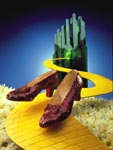
"But it is a long way to the Emerald City,
and it will take you many days.
The country here is rich and pleasant,
but you must pass through rough and
dangerous places before you reach
the end of your journey."
I have often felt a bit like Dorothy when teaching writing. As a social studies teacher, history is my thing and writing was something my students were supposed to learn somewhere else. I quickly learned I wasn't in Kansas anymore after reading the very first paragraph I asked my students to write. And so I embarked upon a journey to discover how to teach writing to middle school students.
Along the way, I have been trained in the Four Square Method, Step Up to Writing, and 6 + 1 Traits. And I have watched districts in our WNY region adopt various writing programs and assessment frameworks to improve student writing across content areas. Each time - we have discovered that there was something small about the wizard behind the curtain. None of these, alone, has helped to improve student writing.
So how do we teach "good writing?" In fact, what is good writing? I am hoping the participants in my workshops and those in the Web 2.0 will add to our learning and conversations as we travel the "rough and dangerous" places!!